Why All AI Writing Sounds the Same (+ How to Fix It)
AI writing sounds identical due to token prediction and training overlap. Learn the technical causes plus practical fixes for style and watermarks.
By The GPT Watermark Remover Team | Last updated: June 2026
Software developers and indie hackers. Background in Flutter, web development, and digital growth. Founders of GPT Watermark Remover, built after watching invisible Unicode characters in AI-generated text trip up ATS systems, academic submission platforms, and content management systems.
The Short Answer
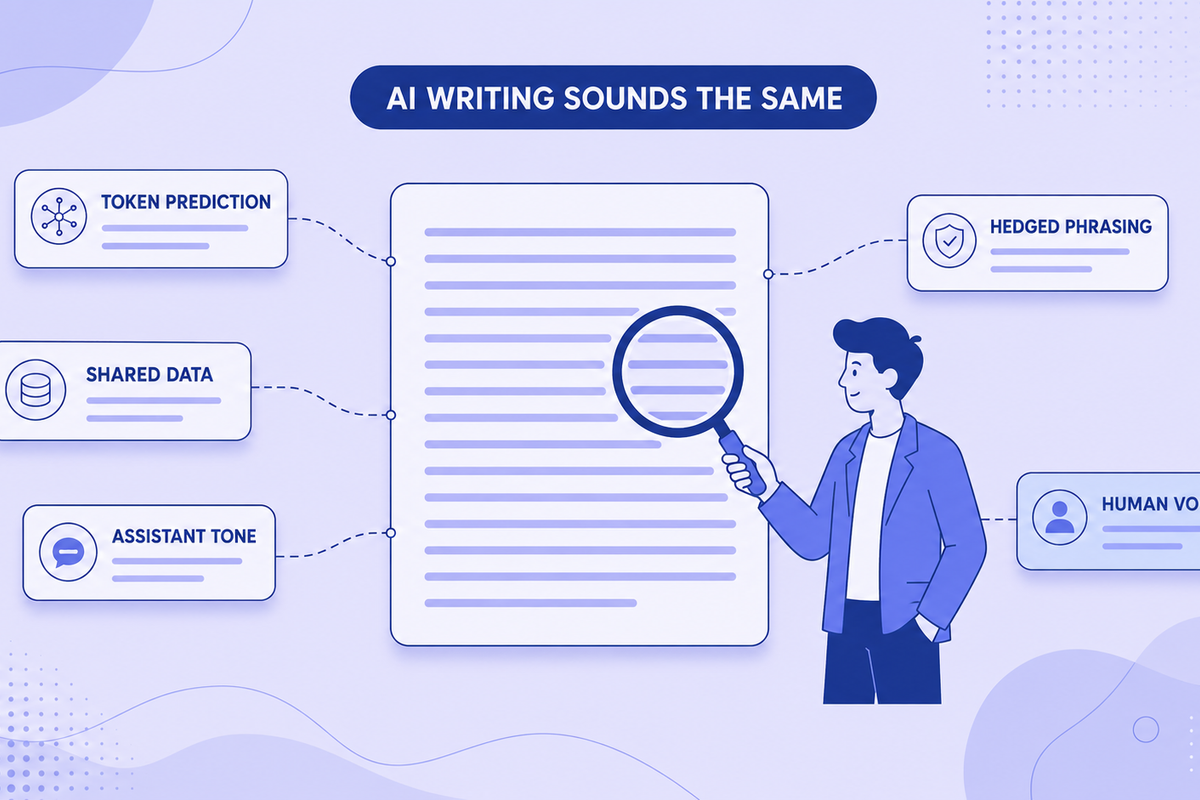
All AI writing sounds the same because large language models are trained to predict the statistically most likely next token, and across millions of training documents, the "most likely" word choices cluster into a narrow band of patterns. The result is prose that defaults to the same sentence openings, the same transitional phrases, the same structural rhythm, and the same hedged, confident-sounding register, regardless of what you asked it to write about.
This is a product of how the models work, compounded by a second layer: post-training alignment fine-tuning, which pushes outputs further toward a particular "helpful assistant" tone. The homogeneity runs deeper than vocabulary. It shows up in sentence length distribution, paragraph structure, and the specific tokens models favour when moving between ideas. If you have ever read a piece of AI-generated text and felt something was slightly off without being able to say exactly what, that feeling is accurate, and this article explains what is actually causing it.
There is also a separate, technical layer that most articles on this topic skip entirely: invisible Unicode watermarks embedded in AI output. These are not about how the text reads. They affect how the text is processed by downstream systems. Understanding both problems, the stylistic and the technical, gives you a clearer picture of what "AI-generated text" actually means in practice.
Why AI Language Models Produce Uniform Output
Every AI language model generates text by assigning probability scores to candidate tokens and selecting from the highest-scoring ones. The training data determines those probabilities, and the training data for models like ChatGPT, Claude, and Gemini is drawn from overlapping pools of internet text, books, and curated documents.
Because the training corpora overlap significantly across competing models, the probability distributions learn similar patterns. "Delve into", "it's worth noting", "at its core", "in conclusion", these phrases score high because they appeared frequently in high-quality writing across the internet, which means every model trained on similar data gravitates toward them independently.
Token prediction creates convergent vocabulary
Token-level prediction means models optimise for local coherence: each word choice looks reasonable given the words before it. This produces text that reads fluently but lacks the long-range idiosyncrasy that characterises individual human writers. A human writer might use an unusual word because it fits their personality, their regional dialect, or a specific connotation they find important. A model uses the token that has the highest probability given context, and across millions of training examples, the highest-probability token is rarely the unusual one.
The practical outcome is a vocabulary squeeze. Certain nouns, verbs, and connectors dominate AI output across all providers because they dominate the training data. Our complete list of common AI words to avoid documents the specific terms that appear with disproportionate frequency in AI-generated text, words that have become reliable signals for detection tools.
RLHF alignment amplifies the problem
Reinforcement Learning from Human Feedback (RLHF) is the fine-tuning stage that shapes how models respond after initial training. Human raters score model outputs, and the model learns to produce text that scores well. The issue is that rater preferences are also drawn from a narrow sample, raters tend to reward confident, clear, balanced, helpful-sounding prose. The models learn that register and apply it regardless of the prompt.
The result is a "helpful assistant" voice that bleeds into everything. Ask an AI to write an angry complaint letter, a casual blog post, or a dry technical document, and the underlying register remains similar. The surface vocabulary may shift, but the cadence and structure stay recognisably the same.
The Structural Patterns That Give AI Text Away
Beyond vocabulary, AI-generated text shows consistent structural fingerprints. Recognising these helps writers understand what to edit, and helps readers understand why the text feels uniform even when individual word choices seem reasonable.
Sentence length distribution
Human writers vary their sentence length with more extreme swings, very short sentences for emphasis, very long sentences for elaboration. AI-generated text tends toward a medium-length distribution with less variance. The rhythm becomes predictable over several paragraphs, which creates a subtle monotony that many readers sense without identifying.
Triadic structures and listing behaviour
Models default to presenting information in threes. Three examples, three bullet points, three aspects of an argument. This is partly a training artifact, structured lists score well in human feedback, and partly a mathematical tendency to balance token sequences. Once you notice triadic structures in AI output, you will find them almost everywhere.
Hedged confidence
AI models are trained to be helpful without being wrong, which produces a distinctive hedging style: "it's important to note", "this may vary", "generally speaking", "in most cases". These qualifiers appear frequently because they reduce the risk of giving incorrect information while maintaining the appearance of being informative. Human writers hedge too, but with more variety and more specificity about what is uncertain and why.
Opening sentence templates
AI writing frequently opens paragraphs with topic-sentence templates: "One of the key...", "When it comes to...", "Understanding [X] is essential to...". These patterns exist because they are common in the training data and score well as paragraph openers. The result is that AI-generated text often feels like it was written from a template, because, in a functional sense, it was.
Why Does My Own Writing Sound Like AI?
Writers who use AI tools frequently, for drafting, for editing, for brainstorming, sometimes find their own prose drifting toward AI patterns. This happens through a well-documented mechanism: exposure to a writing style causes writers to absorb its vocabulary and rhythms, particularly when they spend time reading and editing AI output.
If you find yourself asking "why does my writing sound AI-generated", the most productive diagnostic is to look at your editing habits. Writers who accept AI suggestions frequently, rather than rewriting them in their own voice, gradually replace personal stylistic choices with the model's defaults. The editing stage is where individual voice is either preserved or eroded.
The copy-paste problem
Copying AI output directly into a document and making minor edits preserves the underlying structure. The words may change but the triadic lists, the hedged confidence, and the medium sentence lengths remain. A more effective approach is to use AI output as a factual or structural reference and write the actual prose yourself, starting from a blank line.
Prompting for voice, not content
Most writers prompt AI tools for content, "write me a section about X". A more useful prompt specifies voice constraints: particular sentence lengths, specific vocabulary to avoid, examples of the writer's own past work, and instructions about structural patterns to skip. The model can follow these constraints reasonably well, though the output still needs editing for voice consistency.
The Technical Layer: Invisible Characters in AI Output
Stylistic homogeneity is one problem. The technical layer is separate: some AI-generated text has been observed to contain invisible Unicode characters. These characters are not visible in normal editing, do not affect how the text reads, but do affect how the text is processed by downstream systems.
The characters involved include zero-width spaces (U+200B), zero-width joiners (U+200D), and various ASCII control characters. They can appear at token boundaries in generated text.
For a full technical explanation of how these markers work and what they signal, see our guide to AI text watermarks.
How watermark detection actually works
AI watermarking at the Unicode level involves inserting specific invisible characters at predictable positions, often at word boundaries or between specific token sequences. Detection tools scan for the presence and pattern of these characters.
It is worth being direct about the limits here: detection tools, including ours, produce results based on known watermark types. A model using a novel insertion method, or plain text with no embedded characters, will produce different results. No detection tool produces certainty, only probability and pattern-matching against known signatures. See our analysis of why AI detectors fail for a detailed breakdown of where confidence scores should be trusted and where they should not.
The burstiness signal
One detection signal that works somewhat better than vocabulary-based methods is "burstiness", the variance in sentence length and complexity across a passage. Human writing tends to show higher burstiness: bursts of complexity followed by simple sentences. AI writing flattens this distribution. Detection tools that weight burstiness scores tend to produce fewer false positives against formal human writing, though the method is not definitive.
What Makes Human Writing Sound Human
Human writing contains features that are genuinely difficult for models to replicate because those features arise from personal experience, specific memory, and idiosyncratic perspective, things that cannot be derived from training data alone.
Specific anecdotes with concrete, verifiable details are one marker. A human writer describing a client meeting will include an odd detail that serves no structural purpose, the client's unusual question, the specific city, the thing that went wrong, because that detail is true and memorable. AI models invent plausible details when asked for specifics, but the details tend to be generic because the training data provides the most probable instance of any category, not a specific remembered one.
Opinions with real stakes
Human writers take positions that have costs, professional risk, potential disagreement from an audience, commitment to a view that might be wrong. AI models optimise for harmlessness and helpfulness, which produces balanced, qualified opinions that avoid committing to positions where the model might be corrected. Genuine opinions with stakes are a practical marker of human-authored text.
Structural irregularity
Human writers do not write in neat paragraphs with topic sentences followed by three supporting sentences. They interrupt themselves. They return to earlier points. They change register mid-section. They include one-sentence paragraphs that serve emphasis rather than structure. These irregularities are difficult to replicate through prompting because AI models are trained to produce well-structured text, and "well-structured" in the training data means the regular, organized format that now reads as AI-typical.
How to Make AI-Assisted Writing Sound Less Uniform
If you are using AI tools in your writing workflow, several practical adjustments reduce the homogeneity of the output without requiring you to abandon the tools.
- Write the first draft yourself. Use AI for research, fact-checking, or generating variations on specific phrases, not for generating the initial prose. The first draft sets the voice, and if that draft comes from a model, the voice will be the model's default.
- Rewrite, not edit. When working with AI-generated sections, rewrite paragraphs from scratch using the AI text as a factual reference rather than editing the AI's sentences. Editing preserves structure; rewriting replaces it.
- Vary sentence length deliberately. After drafting, scan your text for sentence length patterns. If most sentences run between 15 and 25 words, introduce some shorter ones (under 10 words) and some longer ones (over 35). This alone significantly changes how the text reads.
- Add a specific detail that only you could know. A data point from your own experience, a conversation you had, a specific project outcome, these details anchor the text in personal experience in ways AI cannot fabricate convincingly.
- Cut the hedges. Remove qualifiers like "it's worth noting", "generally speaking", and "in most cases" where the underlying claim is actually sound. Hedged confidence is a reliable AI signal, stating claims directly reads as more human.
- Break structural symmetry. If you have a list of three items, consider whether one of them should be expanded into its own paragraph, or whether one should be cut entirely. Resisting the triadic default changes the feel of the text.
What Prompted AI Text to All Sound the Same, And Is It Getting Worse?
The convergence of AI writing styles is likely to persist for as long as the models share training data, reward similar outputs through human feedback, and serve a broad general audience. Narrow, specialist models trained on domain-specific corpora with domain-specific rater feedback would produce more distinctive outputs, but that requires investment in data collection and alignment that is more expensive than general-purpose training.
There is a plausible argument that the problem will get worse before it gets better. As AI-generated text proliferates across the internet, future training runs will increasingly ingest AI-written content. The result is a training feedback loop: models trained partly on AI output will produce outputs that more closely resemble the average of all previous AI outputs. This has been called "model collapse" in some technical discussions, though the practical effects on deployed models remain an area of active research.
Differentiation as a professional skill
Writers who can produce text with a recognisable, specific voice, and who understand where AI tools genuinely help versus where they flatten, are likely to become more professionally valuable as AI-generated content becomes more common. The signal value of a distinctive human voice increases as the volume of uniform AI output increases around it.
Why "Humanising" AI Text Is Only Half the Job
A category of tools markets itself as "AI humanisers", services that take AI-generated text and rephrase it to pass detection tools. The approach has two problems worth being clear about.
First, the goal of passing detection tools is a moving target. Detection methods improve, and text that passes today's tools may not pass updated versions. Optimising for detection evasion produces text that is one version behind the current detection state.
Second, humaniser tools typically address surface vocabulary, swapping flagged words for synonyms, adjusting sentence length slightly, without addressing the structural and register-level patterns that make AI text identifiable. The result often reads as human-ish rather than genuinely human-voiced.
A more durable approach is to develop a writing process that uses AI for what it genuinely does well (fast drafting, variation generation, factual research) while preserving the writer's voice at the editing stage. No tool automates this, it requires a deliberate workflow decision. For a broader look at how the humanising category works and where it falls short, see our guide to humanising AI text.
When AI Detectors Flag Human Writing
One of the more practically frustrating consequences of all AI writing sounding the same is that detection tools trained on AI patterns will flag human writing that shares those patterns. This affects writers in high-stakes contexts: students whose human-written essays get flagged, freelancers whose work gets queried by clients using detection tools, and professionals whose formal writing resembles AI output because formal writing and AI output share training data origins.
The practical responses to a false positive are limited. Detection tool operators rarely provide meaningful appeals processes, and the tools themselves do not produce reliable enough results to serve as definitive evidence. The most effective approach is to maintain a documented writing process, drafts, revision history, source notes, that provides provenance evidence independent of any detection score.
For specific contexts like academic submissions, our guide on why your AI detector flags your writing covers the mechanics of why this happens and what the detection scores actually measure.
Summary: Two Separate Problems, Two Separate Fixes
All AI writing sounds the same because of token probability distributions, RLHF alignment, and overlapping training data, these are structural features of how current large language models work, and they produce recognisable stylistic patterns across all major providers.
The fix for stylistic homogeneity is a writing process: rewriting AI output rather than editing it, varying sentence structure deliberately, adding specific personal details, and cutting the hedged qualifiers that signal AI generation.
The fix for invisible Unicode watermarks is a technical tool. GPT Watermark Remover scans for and removes zero-width spaces, zero-width joiners, and ASCII control characters from AI-generated text. It addresses the technical layer that editing for voice does not touch.
Both problems are real. Treating them as the same problem, or ignoring one of them, leads to text that either reads like AI, processes like AI, or both.
Frequently Asked Questions
Why does all AI writing sound the same even when I give it different prompts?
The uniformity comes from the model's training data and alignment fine-tuning, not from the prompt alone. All major models are trained on overlapping internet corpora and fine-tuned to produce helpful, clear, balanced prose. The resulting style is baked into the model's probability distributions and persists across different prompt topics and formats.
Why does my own writing sound like AI-generated text?
Regular exposure to AI output, particularly editing AI drafts rather than rewriting them, causes writers to absorb AI vocabulary patterns and sentence structures. The most reliable diagnostic is to check whether you are preserving AI sentence structures during editing. Starting from a blank line using AI output as reference rather than as a draft prevents this drift.
Why does AI writing have spelling mistakes and odd errors?
Spelling errors in AI output are typically caused by one of two things: hallucinated terms (invented words that do not exist but sound plausible) or autocorrect and encoding issues when AI text is pasted into different applications. Invisible Unicode characters can also cause text to render or export incorrectly in some editing environments, producing apparent errors that are actually encoding artefacts.
What are invisible characters in AI-generated text and why do they matter?
Invisible characters, including zero-width spaces (U+200B) and zero-width joiners (U+200D), are Unicode characters inserted in AI output that do not display in normal editing but affect how text is parsed by software. They can interfere with ATS keyword parsing, academic submission platforms, and content management systems. Removing them produces technically clean text.
Can AI detection tools reliably tell if writing is AI-generated?
AI detection tools measure statistical similarity to known AI output patterns, they do not verify origin. Human writing that is formal, well-structured, and uses common vocabulary can trigger false positives. Detection results are probabilistic, not definitive. No detection tool, including tools that scan for invisible Unicode watermarks, produces certainty about text origin.
Does removing AI watermarks make writing sound more human?
Removing invisible Unicode watermarks addresses a technical problem, hidden characters that affect how software processes your text. It does not change how the text reads or affects stylistic AI detection scores. Making writing sound more human requires editing the prose itself: changing sentence structure, adding specific detail, cutting hedged phrasing, and rewriting rather than lightly editing AI output.
Ready to Remove AI Watermarks?
Try our free AI watermark removal tool. Detect and clean invisible characters from your text and documents in seconds.
Try GPT Watermark RemoverRecommended Articles
Why Is the AI Detector Saying My Writing Is AI? The Complete Guide
Discover why AI detectors flag your human-written text as AI-generated. Learn how detectors really work, the writing patterns that trigger false positives, and practical fixes.
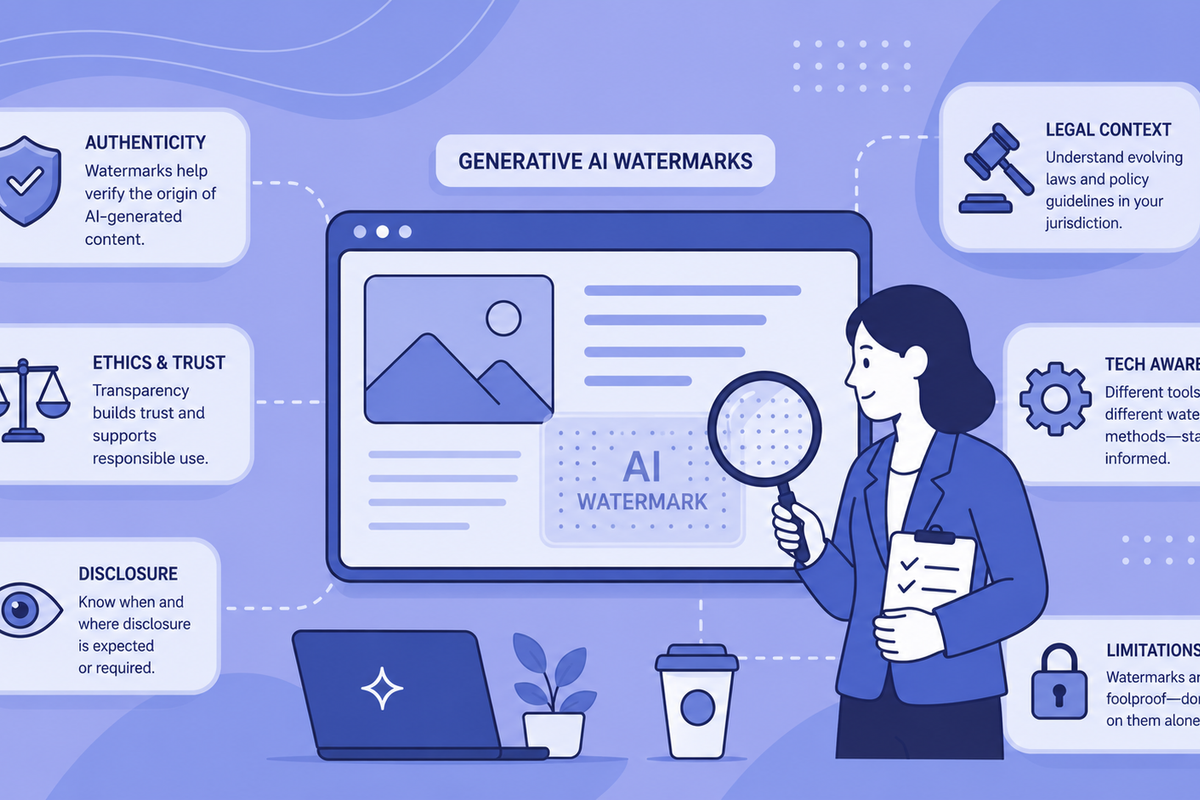
Can Employers Tell If You Used AI? Spotting AI-Generated Text in Job Applications (2026)
Can recruiters detect an AI-written cover letter? What employers actually check in 2026, why AI detectors get it wrong, and why sounding like yourself matters more than hidden characters.